
n8n or Make: which one should your business use for automation?
Author: Adriano Orkisz
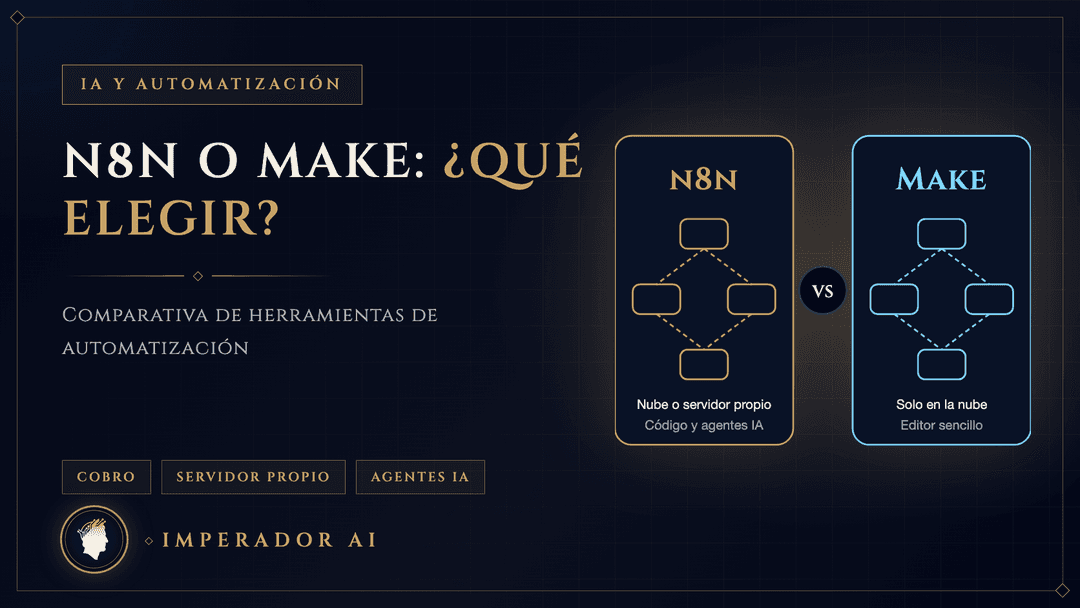
The short answer
Choose Make if you want to connect popular apps quickly and have nobody in IT. Choose n8n if the automation is complex, handles customer data or has to run on your own server. For most small businesses, either tool will do. The difference is in how you are charged and where your data sits.
Comparison
| Criteria | Make | n8n |
|---|---|---|
| Deployment | Make's cloud only | n8n cloud or your own server |
| Ease of use | Very simple visual editor | Visual editor, takes a bit of practice |
| Pricing | Per operation (every step counts as one operation) | In the cloud, per workflow execution; self-hosted, no per-execution fee |
| Ready-made integrations | Very large app catalogue | Large catalogue plus any API through the HTTP node |
| Custom code | Possible, but limited | Nodes with JavaScript and Python |
| AI agents | AI modules available | Built-in nodes for agents and language models |
Check the vendors' websites for current prices and limits, as they change often.
When to choose Make
- You are connecting a few popular apps (a form, Gmail, Sheets, a CRM) and the scenario has only a few steps.
- You want to adjust the automation yourself without knowing how to code.
- Your monthly operation count is small, so per-operation pricing does not hurt.
When to choose n8n
- The scenario has loops, conditions, data processing or calls to your own API.
- You handle customer data and want to keep it on your own server, for example because of GDPR.
- The automation runs thousands of steps a day. With per-operation pricing, the cost in Make climbs quickly.
- You are building an AI agent that uses several tools (for example, a WhatsApp agent with access to a CRM and a calendar).
The hidden cost: maintenance
A self-hosted n8n server has no per-execution fees, but someone has to update it, take backups and deal with outages. If you do not have that person, choose n8n cloud or Make. The tool that is cheaper on the price list can end up costing more in working time.
The same process in Make and n8n: an example
Take a typical enquiry-handling process. A customer fills in a form on your website, and the automation:
- receives the form submission,
- checks whether the contact is already in the CRM and creates or updates it,
- notifies the salesperson on WhatsApp or Slack,
- sends the customer a confirmation email,
- if there is no reply after two days, reminds the salesperson to follow up.
In Make, each of these steps is an operation, so one enquiry uses about five operations, and 300 enquiries a month come to about 1,500 operations. In n8n cloud, the same thing counts as 300 workflow executions, however many steps there are. On a self-hosted n8n server you only pay for the server. With a few dozen enquiries a month, the difference is negligible. With several thousand, and scenarios of a dozen steps or more, it starts to matter.
Customer data and GDPR
An automation moves personal data between systems: names, phone numbers, addresses, the text of messages. Before you choose a tool, answer three questions:
- Where are the data and the execution history stored? In the cloud, check the region your account runs in. On your own server, you choose it.
- Who has access to the accounts and API keys? Access to your CRM, email and shop should be stored in the tool's credentials manager, not pasted into the scenario itself.
- How long do you keep the logs? The execution history contains customer data. Set it to be deleted automatically after a reasonable time.
This is one of the main reasons why companies that handle a lot of customer data choose self-hosted n8n.
Can you move automations from Make to n8n?
Not with one click. A Make scenario has to be rebuilt in n8n, because the two tools describe steps and data differently. In practice we move the logic, not the files: we write down what the scenario does step by step, build it in n8n, and run both in parallel for a few days to compare results. Only then do we switch off the old one.
Common mistakes in automations
- No error handling. If the shop's or the CRM's API does not respond, the scenario stops and nobody knows. Every automation should send an alert when it fails.
- One huge scenario. Fifty steps in a single workflow are hard to fix. It is better to split it into smaller parts that call each other.
- No testing with real data. A test form that you fill in yourself will not show what happens when a customer types a phone number with spaces or leaves a field empty.
- Nobody owns the automation. Someone in the company needs to know what each automation does and who to tell when it breaks.
Frequently asked questions
Is n8n free?
The self-hosted version can run on your own server without a licence fee, within the terms of the vendor's licence. You pay for the server and for the time of whoever maintains it. n8n cloud is paid. Check the licence terms on the n8n website, especially if you want to resell automations to your clients.
Can I use both tools at once?
Yes. Sometimes the marketing team's simple scenarios run in Make, while AI agents and integrations with customer data run in n8n. What matters is knowing which process runs where.
Do I need a developer?
For a simple scenario in Make, no. For complex automations in n8n, custom APIs and AI agents, you will want someone who knows both tools and can keep the data secure. We describe processes worth starting with in 5 processes you can automate, and a full example for online shops in how to automate customer service in e-commerce.
What we use at Imperador AI
We mostly build in n8n, because we deploy AI agents and integrations with clients' own systems. When a client has a simple scenario and wants to change it themselves later, we suggest Make. We choose the tool to fit the process, not the other way round.
Not sure which to choose?
Describe the process you want to automate. In a free audit, we will tell you which tool fits and roughly what it will cost. See the process automation service. If your business is on the Costa del Sol, see also our AI agency in Málaga.