
Holiday rental website in Spain: direct bookings without Airbnb and Booking.com fees
Author: Adriano Orkisz
The short answer
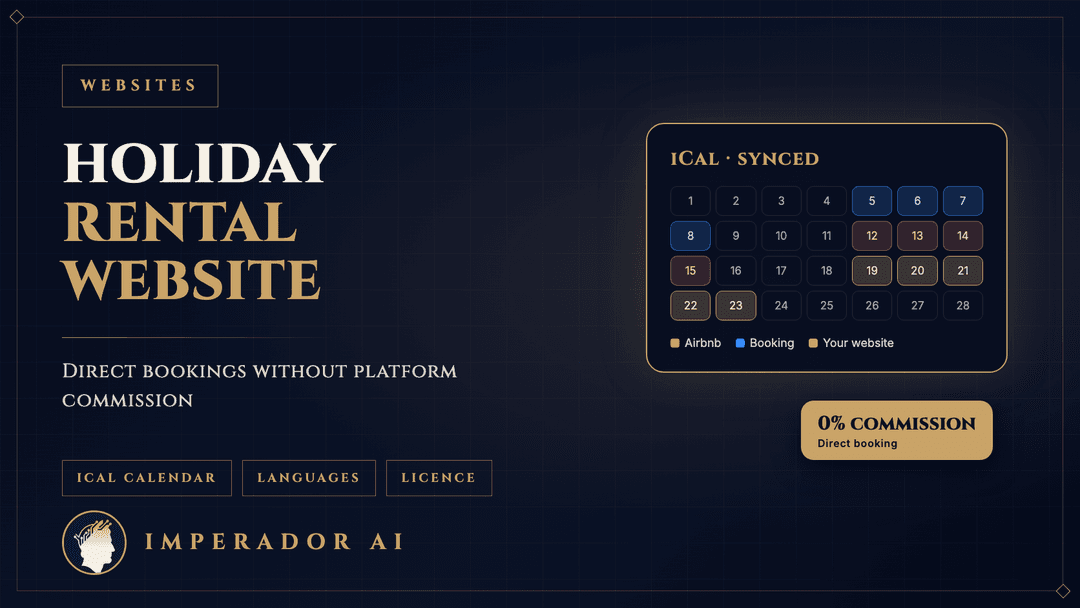
Your own website will not replace Airbnb or Booking.com, but it lets you take bookings without commission from guests who already know you or who find you on Google. To work, it needs four things: a calendar synced with the platforms so you never get double bookings, clear seasonal prices, a version in each guest's language, and a quick way to book or ask a question, for example on WhatsApp.
What the platforms cost you
Booking.com charges hosts a commission on every booking, usually around 15% of the total, although the rate depends on the area and the programmes you take part in. Airbnb puts most hosts on its host-only fee of about 15.5%, and in Europe VAT is added on top. Always check the exact rate in your account, as the terms change.
A simple example: if your property takes €30,000 a year in bookings and you pay 15% on average, that is €4,500 in commission. If one booking in five comes directly through your website, you save about €900 a year on a single property. With several properties, the website pays for itself quickly.
The platforms are still useful
There is no point leaving Airbnb and Booking.com. They bring you guests who would never have found you otherwise. Your website does a different job:
- Returning guests. Someone who has stayed with you can book directly next time.
- Google searches. For example "apartment with pool in Fuengirola" or "holiday home in La Herradura".
- Recommendations. A guest's friend gets a link to your website, not to one listing among hundreds.
- Trust. A website with your own brand inspires more confidence than a platform profile, especially for long or expensive stays.
What a holiday rental website needs
A calendar synced with Airbnb and Booking.com
Availability on the website syncs with the platforms through iCal: when someone books on Booking.com, those dates are blocked on your website and on Airbnb. Bear in mind that iCal updates every so often, not instantly. If your occupancy is high, a channel manager that syncs in real time is a better choice.
Seasonal prices and simple booking
Guests need to see the price for their dates without having to message anyone. They can pay on the website or send a booking request that you confirm. The second option is easier to start with.
One language per audience, each with its own address
On the Costa del Sol and the Costa Tropical, guests are British, German, Scandinavian, Dutch or Polish. Each language should have its own URLs and hreflang tags so that Google shows everyone the right version. An automatic translation widget on top of the site does not rank.
Tourist licence number on display
In Andalusia every holiday let must be registered in the Andalusian Tourism Register (Registro de Turismo de Andalucía). Show that number on each property page: the regional rules require it in advertising, and it builds trust.
Fast photos on mobile
Most guests look at the website on their phone. Photos need to load at the right size and in modern formats. A gallery of 40 unoptimised photos sends guests back to Booking.com.
WhatsApp and replies in the guest's language
Many guests prefer to ask before booking: parking, pets, arrival time. A WhatsApp button that is always visible helps. If you get a lot of questions, an AI agent can reply at any hour in the guest's language and pass you only what needs a person.
Automatic messages before and after the stay
Booking confirmation, arrival instructions a few days before check-in, a reminder on departure day and a request for a review at the end. All of it can go out automatically, at the right moment and in each guest's language.
The rules in 2026, briefly
The rules for holiday lets in Spain have changed several times in recent years. The national short-term rental register (the NRUA number), required to advertise on platforms from July 2025, was annulled by Spain's Supreme Court in May 2026. Regional registers, such as the Andalusian one, still apply. Before you publish or change anything, check your property's situation with your gestor or town hall. This article is not legal advice.
How to get your first direct bookings
- Keep every guest's contact details and, with their permission, write to them before the next season with a link to your website.
- Give a reason to book direct, such as a slightly lower price or cleaning included. You still earn more than you would after commission.
- Leave a QR code in the property that links to your website and your reviews page.
- Create a page for each property and area, with its own text and photos, so you show up in local searches.
What it costs and how long it takes
| Project | Guide price | Timeline |
|---|---|---|
| Landing page for one property | from €350 | about 2 weeks |
| Website with several properties, calendar and languages | €1,500 – 8,000 | 1 – 8 weeks |
| WhatsApp AI agent | from €2,000 | 3 – 10 weeks |
Prices are net and approximate. They depend on the number of properties, languages and integrations. More detail in how much a website costs in 2026 and how much a WhatsApp AI agent costs.
A real example
We built the website of an estate agency in La Herradura that sells and rents across Andalusia. Its holiday rental calendar syncs with Booking.com and Airbnb through iCal, it has seasonal prices and the tourist licence number on every property, in five languages. See the real estate agency website case study.
We work with owners and rental managers across Spain. If you are in the area, see our pages on web design in Fuengirola, Marbella and Granada and the Costa Tropical. Tell us how many properties you have and we will reply within 24 hours with a proposal, timeline and price.