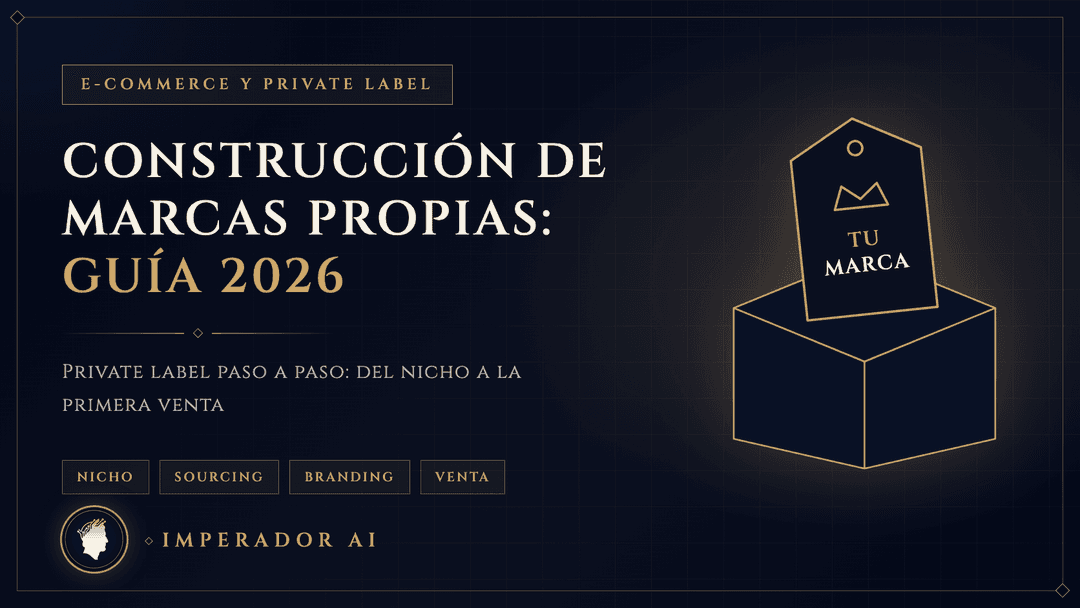
Building Your Own Brand: The Complete 2026 Guide to Private Label
Author: Adriano Orkisz
Introduction: why building your own brand is the best business decision of this decade
When you sell other people's products, you compete on price with anyone who has the same product. Dropshipping margins sit around 5–15%, retail arbitrage means constantly hunting for opportunities, and reselling established brands means competing with dozens of identical offers. Building your own brand - the private label model - is completely different: you build an asset with its own value, independent of any single platform or algorithm.
This guide goes step by step: from the idea, through sourcing and branding, to your first sale on Amazon or in your own store.
What is a private label brand, and why is everyone talking about it?
A private label brand is a business model in which you order products from a manufacturer but sell them under your own name, with your own logo and packaging. The manufacturer produces. You build the brand, the customer relationship and the recognition.
Private label works especially well in categories such as supplements, cosmetics, pet accessories and kitchen items.
Why? Because customers buy a "brand" in the traditional sense less and less. They buy quality, a story and a fit with their values - and you can build that from the ground up without a multi-million marketing budget.
Private label vs. dropshipping vs. arbitrage - which model is profitable in 2026?
| Model | Net margin | Barrier to entry | Scalability | Long-term value |
|---|---|---|---|---|
| Dropshipping | 5–15% | Low | Limited (the supplier decides) | Low - no assets |
| Retail arbitrage | 10–25% | Medium | Low (your time is the bottleneck) | Low - doesn't scale |
| Brand reselling | 10–30% | Medium | Medium | Low - dependent on licences |
| Own brand / Private Label | 35–65% | Medium–high | High | High - a sellable asset |
The conclusion is simple: building your own brand is the only model that creates a real business asset. A brand can be sold, licensed or scaled into new categories. A list of dropshipping products cannot.
6 steps to build a private label brand from scratch
Step 1 - Market research and choosing a niche
This is the most important stage. Most entrepreneurs make their first and biggest mistake here: they choose the category they like, not the one with real demand and manageable competition.
What you are looking for in a good niche for a private label brand:
- Demand: at least 300–500 sales a month for the top 10 products in the category (use Amazon BSR as a reference)
- Price: 25–80 EUR - best for margin and logistics
- Few reviews among competitors - ideally the top 10 have fewer than 500 reviews, which makes entry viable
- Room to differentiate - a premium version, extra features, better packaging, better communication
- Low seasonality - the product sells all year, not just in Q4
Research tools: Helium 10, Jungle Scout, Google Trends, Ubersuggest, Ahrefs. For the Spanish market: Amazon.es BSR data, competitors' Google Search Console.
Step 2 - Validate demand before you spend a euro
Got a niche? Don't order samples yet. First validate demand on a small scale:
- Create a pre-launch landing page and collect emails from interested people
- Run a Google Ads or Meta Ads campaign with 100–200 EUR and check the CPC for your keywords
- Analyse trends on Amazon.es for similar products
- Join Facebook groups or specialist forums and ask directly: "Would you pay X for product Y with feature Z?"
If you can't collect 100 emails from interested people with a 100 EUR budget, either you've profiled the niche badly or the value proposition is too weak. Better to know now than after ordering 500 units of product.
Step 3 - Sourcing products for private label
Sourcing, finding the right manufacturer, is usually the biggest source of stress when building your own brand. You have two main routes:
Europe (Spain, Portugal, Italy, Germany, Poland):
- Higher unit cost (30–80% more than Asia)
- Short delivery times (1–2 weeks)
- Easier communication, a higher quality standard, CE certificates available
- Best for: cosmetics, food, supplements, textiles
- Where to look: EUROPAGES, trade fairs (Alimentaria, Cosmobelleza, FITUR)
Asia (China, India, Thailand):
- Lower unit cost - key to a higher margin
- Delivery times: 30–50 days (sea) or 10–14 days (air)
- You need to verify quality and EU certificates (CE, RoHS, REACH)
- Best for: electronics, accessories, sports equipment, pet products
- Where to look: Alibaba, Global Sources, the Canton Fair
The golden rule of sourcing: never buy without a sample. Always ask for them - they are the cheapest quality test there is. Request samples from 3–5 suppliers and compare quality, communication and delivery times before you decide.
Step 4 - Branding: logo, packaging and visual identity
This is where a private label brand separates itself from a generic product. Packaging and visual identity influence whether the customer clicks "buy" and how much they pay.
What full branding for a private label brand includes:
- Naming - a simple, memorable name that is available as a domain and a trademark
- Logo and visual system - main logo, variants (light/dark), favicon, icons
- Colour palette and typography - consistency across every customer touchpoint
- Packaging design - box, bag, label: it should look premium even on a tight production budget
- Brand manual - a document with usage rules that keeps everything consistent as you scale
Investing in professional branding is not a cost, it's a competitive advantage. A product identical to the competition's, well packaged and with a stronger brand story, sells for more and sells faster.
Step 5 - Sales channels: Amazon, your own store, marketplaces
The best strategy for private label in Spain and Europe is to sell through several channels from the start. Don't depend on a single channel - algorithms change and platform rules evolve.
Amazon FBA:
- Existing traffic: customers who already buy on Amazon
- Amazon handles storage, packing and shipping
- The key is listing optimisation (title, bullet points, A+ Content, photos)
- Fee: 8–15% of the sale plus FBA fees (~1–3 EUR per unit)
Your own store (Shopify / Next.js):
- Full control of your margin - no sales commission
- Your own customer base, emails, room to build loyalty
- Needs a traffic budget (SEO, ads, social media)
Step 6 - Launch, reviews and first revenue
The hardest stage of any new brand: without reviews there are no conversions. How to break that paradox:
- Launch offer - for the first 2–4 weeks, a reduced price or discount (–20–30%) for first customers in exchange for organic reviews
- Product insert - a card in the packaging asking for a review, with a QR code
- Follow-up email - an automatic email 7 days after delivery asking about the experience
- Micro-influencers - work with 5–10 creators (5k–50k followers) in exchange for product or a small fee
Target: 25–50 reviews in the first month. That is the threshold at which Amazon's algorithm and customers start treating the product as reliable.
How much does it cost to build your own brand? Real ranges for 2026
| Item | Starter package | Growth package | Premium package |
|---|---|---|---|
| Market research | DIY (tools: ~50 EUR/month) | From 350 EUR | From 700 EUR |
| Sourcing + samples | 200–500 EUR | 500–1,500 EUR | 1,500–4,000 EUR |
| Initial order (MOQ) | 800–2,500 EUR | 2,500–6,000 EUR | 6,000–15,000 EUR |
| Branding (logo + packaging) | 800–2,000 EUR | 2,000–5,000 EUR | From 6,000 EUR |
| E-commerce store | Shopify (~30 EUR/month) | From 1,500 EUR (Next.js) | From 4,000 EUR |
| Launch marketing | 300–800 EUR | 1,500–4,000 EUR | 4,000+ EUR |
| TOTAL (estimate) | 2,000–6,000 EUR | 8,000–18,000 EUR | 20,000+ EUR |
With a well-chosen niche, a 45–55% margin and a properly optimised listing, the first net profits usually arrive in month 3–5. Full return on investment: 6–12 months.
The most common mistakes when building your own brand
- A niche that is too broad - "cosmetics" is not a niche. "Retinol face serum for women 35+" is.
- Skipping demand validation - ordering 1,000 units without a test is the fastest route to a loss. Always validate before the full order.
- Saving on branding - a generic look means a generic price. Professional packaging isn't a luxury, it's the basis of a premium price.
- Depending on one channel - Amazon alone is a risk. An algorithm change or an account suspension means zero revenue.
- Ignoring logistics - shipping costs, duties, FBA storage: if you don't calculate them from the start, your margin disappears in fulfilment.
Frequently asked questions about building your own brand
Do I need a company to sell private label?
Not necessarily - you can start as a sole trader (autónomo in Spain). Once your activity passes 50–80k EUR in annual turnover, consider setting up an SL (limited company) to protect your personal assets and optimise tax.
How long does it take from idea to first sale?
With a streamlined process: 8–14 weeks. Market research: 2 weeks. Sourcing and samples: 2–4 weeks. Branding: 2–3 weeks. Production and delivery: 2–6 weeks. The stages can overlap if you work in parallel.
Can I build my own brand without a warehouse?
Yes - Amazon FBA removes the need for a warehouse entirely. You send the goods to an Amazon fulfilment centre and the platform handles the rest. For your own store you can use 3PL (third-party logistics) services.
Summary - 5 principles for building your own brand successfully
- Niche > category - the more focused the product, the easier it is to stand out at the start
- Validate before you invest - demand has to be confirmed with data, not intuition
- Invest in branding - packaging and visual identity are your main advantage over a generic product
- Multichannel from day zero - Amazon + your own store + a marketplace = spread risk
- A brand is an asset - you are building something with value independent of today's sales
Building your own brand is not a sprint - it's a marathon with a very attractive finish line. If you want to go through this process with a partner who has already delivered dozens of similar projects in Poland and Spain - get in touch. The first consultation is free, concrete and carries no obligation.